

25 Bible Verses on Overcoming Fear and Anxiety
At certain moments in our lives, we sometimes feel overwhelmed by our thoughts and feel pressured by life itself. We sadly feel depressed, alone, sad, and feel we have to fight this battle, but we still feel too weak to fight.
As a believer, this is something I have also experienced. Honestly, it is not the best feeling. You feel crushed and do not know where to turn to. As believers, the last weapon we have left after a heavy defeat is the Word of God.
As a Christian who has been through fear and anxiety, I can confidently share with you the Bible verses that not only helped me in those desperate times, but have also changed my approach to the matter.
Bible verses on overcoming fear and anxiety are more than just comforting words—they’re divine weapons against the worries that steal our peace. These Scriptures have the power to rewire our thought patterns, anchor our spinning minds, and remind us of truths bigger than our circumstances.
In the next few minutes, you’ll discover 25 powerful Bible passages that have sustained believers through their darkest valleys. Whether you’re battling panic attacks, chronic worry, or specific fears about health, finances, or the future, God’s Word offers both comfort and courage.
What Are Bible Verses for Fear and Anxiety?
Bible verses about fear and anxiety are Scripture passages that specifically address our human struggles with worry, dread, and overwhelming stress. These verses aren’t just nice platitudes—they’re God’s direct promises, commands, and reassurances to His people when we face frightening circumstances.
Throughout the Bible, God commands us “do not fear” or “fear not” over 365 times—one for every day of the year. This repetition isn’t accidental. Our loving Father knows that fear is a universal human experience, and He’s given us His Word as an anchor when anxiety threatens to pull us under.
These verses work because they shift our focus from our circumstances to God’s character. They remind us that we’re not alone, we’re not forgotten, and we serve a God who is infinitely more powerful than whatever we’re facing. When we meditate on these truths, they gradually transform our minds and calm our anxious hearts.
25 Bible Verses to Overcome Fear and Anxiety
Verses for God’s Presence in Fear
When fear makes us feel isolated and alone, these verses remind us that God never leaves our side.
1. Isaiah 41:10
“So do not fear, for I am with you; do not be dismayed, for I am your God. I will strengthen you and help you; I will uphold you with my righteous right hand.”
When anxiety strikes, speak this verse aloud. Notice God doesn’t say “if” you’re afraid—He acknowledges you might be. His promise isn’t that you’ll never feel fear, but that He’ll be WITH you in it. Today, when worry creeps in, literally picture God’s right hand holding you upright.
Practical step: Create a note on your phone with this verse. Set it as a daily alarm for your most anxious time of day.
2. Deuteronomy 31:6
“Be strong and courageous. Do not be afraid or terrified because of them, for the LORD your God goes with you; he will never leave you nor forsake you.”
This verse was spoken to the Israelites facing an intimidating battle. Whatever “battle” you’re facing—medical, financial, relational—God is already there ahead of you. He hasn’t sent you alone.
Practical step: Before entering a situation that causes anxiety (a difficult conversation, a doctor’s office, a job interview), pause outside and pray: “God, You’re already in that room. Go with me.”
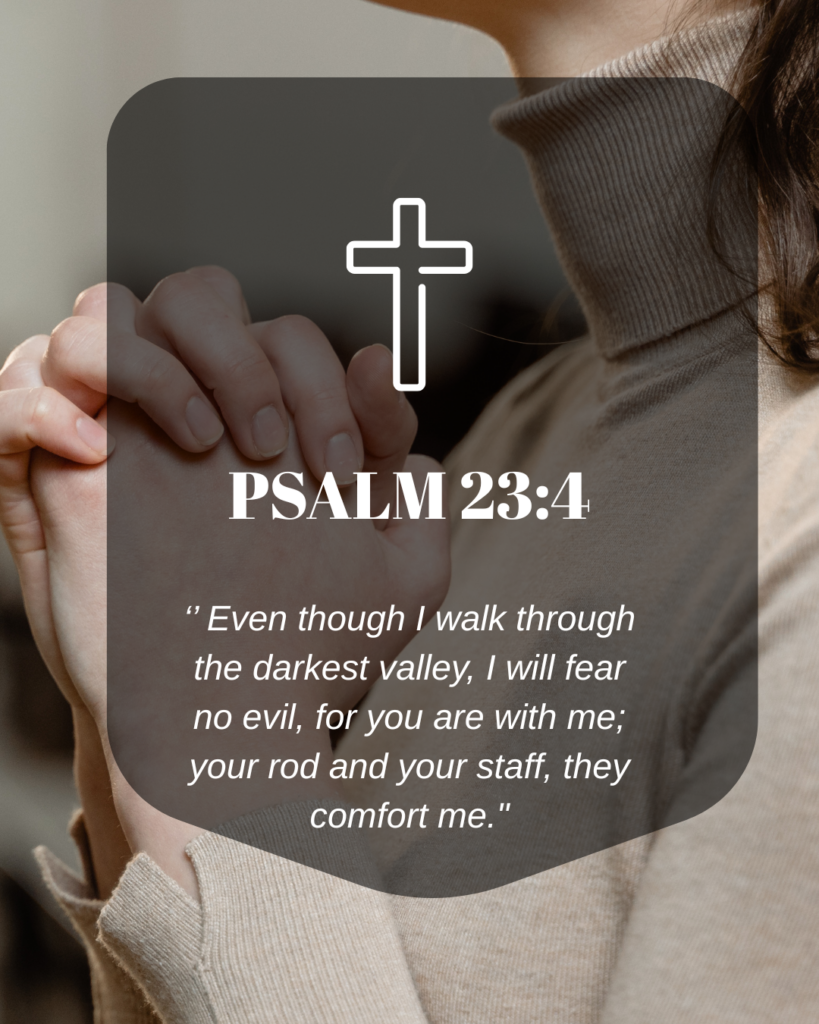
3. Psalm 23:4
“Even though I walk through the darkest valley, I will fear no evil, for you are with me; your rod and your staff, they comfort me.”
Notice David says “through”—not “if I walk” or “when I arrive.” You’re passing through, not setting up camp. The valley is temporary. God’s presence is permanent.
Practical step: When going through a dark season, journal about the valleys you’ve already walked through and survived. Let your history with God build your trust for today.
4. Joshua 1:9
“Have I not commanded you? Be strong and courageous. Do not be afraid; do not be discouraged, for the LORD your God will be with you wherever you go.”
God’s presence isn’t limited to church buildings or quiet prayer times. He’s with you in the hospital room, the courtroom, the unemployment office, the middle school cafeteria. Wherever your “wherever” is, He’s already there.
Practical step: Choose one place that triggers anxiety for you. Each time you’re there this week, remind yourself: “God is here with me right now.”
5. Psalm 46:1-2
“God is our refuge and strength, an ever-present help in trouble. Therefore we will not fear, though the earth give way and the mountains fall into the heart of the sea.”
Even in worst-case scenarios—when everything feels like it’s collapsing—God remains our refuge. Your circumstances might be unstable, but your God is not.
Practical step: Make a “refuge list.” Write down 3-5 ways you can practically run to God when panic hits (prayer, worship music, calling a Christian friend, reading Scripture).
6. Matthew 28:20
“And surely I am with you always, to the very end of the age.”
Jesus’ last promise to His disciples before ascending to heaven was His continual presence. Not His occasional presence. Not His presence when you’re being good enough. Always means always.
Practical step: Set hourly reminders that simply say, “Jesus is with me right now.” Let this truth interrupt your anxious thoughts throughout the day.

Verses for Releasing Anxiety to God
These verses teach us the practice of surrender—giving our worries to the One who can actually do something about them.
7. 1 Peter 5:7
“Cast all your anxiety on him because he cares for you.”
“Cast” is an active verb—it means throw, hurl, fling. Don’t politely hand God your anxiety. Throw it at Him. He can handle it. And notice: He doesn’t just take our anxiety out of duty. He takes it because He cares deeply about you.
Practical step: Try “worry time” prayer. Set aside 10 minutes to literally list out every single worry to God. Then physically close your journal or turn off your device as an act of releasing those worries to Him.
8. Philippians 4:6-7
“Do not be anxious about anything, but in every situation, by prayer and petition, with thanksgiving, present your requests to God. And the peace of God, which transcends all understanding, will guard your hearts and your minds in Christ Jesus.”
Notice the formula: Don’t be anxious → Pray about everything → Add gratitude → Receive supernatural peace. That peace won’t always make logical sense (“transcends understanding”), but it will guard your heart like a soldier. If you wanna learn more check this out, https://www.youtube.com/watch?v=ExwezfUG0Qk
Practical step: Start an “anxiety exchange” journal. On the left side, write your worry. On the right side, write a prayer giving it to God plus one thing you’re thankful for. Then note any peace you experience.
9. Psalm 55:22
“Cast your cares on the LORD and he will sustain you; he will never let the righteous be shaken.”
You don’t have to have it all figured out before bringing it to God. Come with your messy, overwhelming cares. His job is to sustain you—not yours.
Practical step: Create a “God’s got this” box. Write your worries on paper and physically place them in the box. When you’re tempted to take back that worry, remind yourself it’s in God’s hands now.
10. Matthew 6:34
“Therefore do not worry about tomorrow, for tomorrow will worry about itself. Each day has enough trouble of its own.”
Most anxiety is about things that haven’t happened yet. Jesus tells us to stay present. You don’t need grace for tomorrow’s trouble today—you only need grace for today’s challenges, and He’s already provided that.
Practical step: When you catch yourself worrying about the future, literally say out loud: “That’s tomorrow’s problem. What does today actually require of me?” Then focus only on today.
11. Psalm 94:19
“When anxiety was great within me, your consolation brought me joy.”
Notice this psalmist doesn’t pretend they weren’t anxious. They were honest about their “great” anxiety. But they were equally honest about God’s comfort bringing them joy. Both can be true.
Practical step: Practice “spiritual bookends” for your day. Start each morning by acknowledging your anxieties to God, and end each evening by thanking Him for specific ways He consoled you that day.
12. Proverbs 12:25
“Anxiety weighs down the heart, but a kind word cheers it up.”
Anxiety is literally heavy—it weighs us down physically, emotionally, and spiritually. But God’s kind words (Scripture) have the power to lift that weight. His Word isn’t a band-aid; it’s healing medicine.
Practical step: Choose one “kind word” verse from this list that resonates most with your current struggle. Write it on your bathroom mirror so it’s the first thing you see each morning.

Verses for Courage and Strength
When fear tries to paralyze us, these verses empower us to take the next brave step.
13. 2 Timothy 1:7
“For the Spirit God gave us does not make us timid, but gives us power, love and self-discipline.”
If you’re a believer, you don’t have a spirit of fear—that’s not your identity. You have the Holy Spirit, who brings power, love, and sound judgment. Your feelings of fear don’t define you; God’s Spirit in you does.
Practical step: When fear tells you “I can’t do this,” interrupt that thought with truth: “The Spirit in me gives me power. I can do this with God’s help.”
14. Psalm 27:1
“The LORD is my light and my salvation—whom shall I fear? The LORD is the stronghold of my life—of whom shall I be afraid?”
David asks rhetorical questions to confront his own fear. Try it yourself: If God is my protector, what can man actually do to me? If God controls my future, what do I really need to fear?
Practical step: When facing something intimidating, ask yourself David’s questions: “Whom shall I fear? Of whom shall I be afraid?” Let the answer (“no one, because God is my stronghold”) reframe your perspective.
15. Isaiah 43:1-2
“Do not fear, for I have redeemed you; I have summoned you by name; you are mine. When you pass through the waters, I will be with you; and when you pass through the rivers, they will not sweep over you.”
God doesn’t promise you’ll avoid hard things (“when” you pass through waters—not “if”). But He promises the waters won’t drown you. There’s a difference between going through something difficult and being destroyed by it.
Practical step: Make a list titled “Hard Things I’ve Survived.” Let it serve as evidence that God has brought you through before and will do it again.
16. Psalm 118:6
“The LORD is with me; I will not be afraid. What can mere mortals do to me?”
When you’re afraid of people—their judgment, their power over you, their opinions—remember they’re “mere mortals.” They don’t control your destiny. God does.
Practical step: Before a situation involving someone who intimidates you, pray: “God, You’re bigger than this person. Help me see them as You see them—as someone You love, not someone I should fear.”
17. Romans 8:31
“What, then, shall we say in response to these things? If God is for us, who can be against us?”
“If” here means “since”—it’s not a question of whether God is for you. He is. Settled. So the question becomes: Does it really matter who’s against you when the Creator of the universe is on your team?
Practical step: Create a “God is for me” list. Write down specific Bible verses and life experiences that prove God is for you. Read it when you feel opposed.
18. Deuteronomy 3:22
“Do not be afraid of them; the LORD your God himself will fight for you.”
Sometimes the most courageous thing you can do is stop fighting and let God fight for you. Your job is to trust. His job is to battle.
Practical step: Identify one situation where you’re exhausted from fighting. Pray: “God, I’m stepping back. This is Yours to fight. Show me where You’re working.”

Verses for Peace and Trust
These final verses guide us into the peace that comes from trusting God completely.
19. John 14:27
“Peace I leave with you; my peace I give you. I do not give to you as the world gives. Do not let your hearts be troubled and do not be afraid.”
Jesus offers a different kind of peace than the world offers. Worldly peace depends on circumstances being okay. Jesus’ peace exists even when circumstances aren’t okay—it’s rooted in His presence, not your situation.
Practical step: When anxiety spikes, practice “peace breathing.” Inhale slowly while praying “Jesus, give me Your peace.” Exhale slowly while releasing the anxious thought.
20. Proverbs 3:5-6
“Trust in the LORD with all your heart and lean not on your own understanding; in all your ways submit to him, and he will make your paths straight.”
“Lean not on your own understanding” is perhaps the hardest command for anxious minds. We want to figure everything out, control every variable. God asks us to trust Him, even when we don’t understand.
Practical step: When you can’t figure something out, stop trying for a moment. Pray: “God, I don’t understand this. But I trust You. Show me the next right step.”
21. Isaiah 26:3
“You will keep in perfect peace those whose minds are steadfast, because they trust in you.”
Perfect peace comes from a steadfast (focused, fixed, unwavering) mind on God. Not a mind that never has anxious thoughts, but a mind that keeps returning to focus on God.
Practical step: Practice the “redirect” method. When an anxious thought comes, acknowledge it (“I notice I’m worried about X”), then redirect to God (“But I’m choosing to focus on God’s faithfulness instead”).
22. Psalm 34:4
“I sought the LORD, and he answered me; he delivered me from all my fears.”
Deliverance from fear often doesn’t happen instantly—it happens as we consistently seek God. David sought the Lord first, then experienced deliverance. The order matters.
Practical step: Commit to seeking God first—before googling symptoms, before texting a friend, before spiraling into worst-case scenarios. Make Him your first response to fear.
23. Nahum 1:7
“The LORD is good, a refuge in times of trouble. He cares for those who trust in him.”
God isn’t just powerful—He’s good. His goodness means He uses His power for your benefit, not to harm you. You can trust Him because He cares about you personally.
Practical step: Start a “God’s goodness journal.” Each day, write one specific way you saw God’s goodness, even in small things. Let this evidence build your trust.
24. Romans 8:38-39
“For I am convinced that neither death nor life, neither angels nor demons, neither the present nor the future, nor any powers, neither height nor depth, nor anything else in all creation, will be able to separate us from the love of God that is in Christ Jesus our Lord.”
Application: Make a list of your biggest fears. Death? On the list. Financial disaster? Covered under “life” circumstances. Future unknowns? Specifically mentioned. Nothing can separate you from God’s love—literally nothing.
Practical step: When fear says “what if X happens?” counter it with Romans 8:38-39: “Even if X happens, I’m still loved by God. Even if Y happens, I’m still secure in Christ.”
25. Psalm 56:3-4
“When I am afraid, I put my trust in you. In God, whose word I praise—in God I trust and am not afraid. What can mere mortals do to me?”
This verse gives us the formula for fear: Feel the fear → Choose trust → Praise God’s Word → Experience freedom from fear. It’s not “if” you’re afraid, it’s “when”—and you have a battle plan.
Practical step: Create a fear response card to keep in your wallet. Write: “When I’m afraid: 1) Acknowledge it to God, 2) Choose to trust Him, 3) Speak truth from His Word, 4) Thank Him for His faithfulness.”
Practical Steps to Use These Bible Verses Daily
Knowing these verses is powerful. Applying them is transformative. Here’s how to make Scripture your daily weapon against fear and anxiety:
Morning Anchor Practice: Start each day by reading one verse from this list aloud before checking your phone. Speak it over your day. Declare it over your fears. Let God’s truth be the first voice you hear.
Memorization Through Movement: Choose one verse per week to memorize. Write it on sticky notes and place them where anxiety hits hardest—your bathroom mirror, car dashboard, computer monitor, or beside your bed. Read it every time you see it until it’s written on your heart.
Anxiety Interruption Strategy: When panic strikes, don’t just try to calm down—replace the anxious thought with Scripture. Keep a note on your phone titled “Truth for My Fears” with your top 5 verses from this list. Read them when worry spirals.
Scripture Meditation Before Sleep: Instead of lying awake rehearsing your fears, choose one verse to meditate on as you fall asleep. Slowly repeat it, phrase by phrase, letting it fill your mind until sleep comes.
Community Sharing: Share one verse from this list with a trusted friend who also battles anxiety. Text it to each other when one of you is struggling. Remind each other of truth when fear feels louder than faith.
Prayer Journaling: Write out your anxious thoughts, then counter each one with a verse from this list. Watch how God’s Word addresses your specific fears. Keep this journal as evidence of God’s faithfulness. If you want to learn how to start an effective prayer journal, read this How To Start A Prayer Journal. Learn 5 Effective Steps
A Prayer to Overcome Fear and Anxiety
Father God, I come to You with trembling hands and an anxious heart. I confess that fear has felt bigger than my faith lately. The worries feel endless, and I’m exhausted from carrying what was never mine to carry.
Thank You for these 25 verses that remind me who You are when I forget. You are with me. You are for me. You are bigger than whatever I’m facing. Your love cannot be shaken by my circumstances.
I choose today—right now in this moment—to cast my anxiety on You. I’m throwing my worries at Your feet, trusting that Your shoulders are big enough to carry what mine cannot. Replace my fear with Your peace. Replace my racing thoughts with Your truth. Replace my panic with Your presence.
Help me to remember these verses when 2 AM comes and the fears crowd in. Bring them to my mind when anxiety sneaks up during the day. Let Your Word be louder than my worry. Let Your promises be stronger than my panic.
I trust You, not because I understand everything, but because You’ve proven faithful before and You’ll prove faithful again. Thank You for never leaving me alone in my fear. Thank You for giving me Your Word as a weapon and Your Spirit as my courage.
In Jesus’ mighty name, the One who defeated death and can certainly handle my anxiety, Amen.
Frequently Asked Questions
How many times does the Bible say “fear not”?
The phrase “fear not” or “do not fear” appears over 365 times throughout the Bible—once for every day of the year. This isn’t coincidence. God knows fear is a daily battle for humans, and He’s given us a daily reminder that we don’t have to live in bondage to it. From Genesis to Revelation, God consistently tells His people that fear isn’t His plan for us.
What does the Bible say about anxiety and depression?
The Bible acknowledges anxiety and depression as real human struggles. Psalms is filled with David’s honest cries of despair. Jesus Himself was “deeply distressed and troubled” in the Garden of Gethsemane.
Scripture never shames us for these feelings, but it does offer a path forward: bringing our burdens to God, meditating on truth instead of lies, and finding community. While the Bible offers spiritual comfort, it doesn’t forbid us from also seeking professional help—medication and therapy can be gifts from God too.
Can Bible verses really help with panic attacks?
Yes, but not like magic words. Bible verses work by gradually rewiring our thought patterns through repeated exposure to truth. During a panic attack, Scripture can serve as a cognitive anchor—giving your mind something concrete and true to focus on when everything feels chaotic.
Many people find that memorizing short verses like “God is with me” or “I will not fear” provides immediate comfort in acute anxiety moments. Over time, consistent meditation on Scripture actually changes our baseline anxiety levels.
What’s the best Bible verse for fear?
The “best” verse depends on your specific struggle, but Isaiah 41:10 is often considered the most comprehensive: “Fear not, for I am with you; be not dismayed, for I am your God.
I will strengthen you, I will help you, I will uphold you with my righteous right hand.” It addresses fear, promises God’s presence, acknowledges our weakness, and guarantees His help. Start here if you’re unsure where to begin.
How do I overcome fear according to the Bible?
Biblical fear-fighting isn’t about eliminating fear entirely—it’s about choosing faith despite fear. The pattern throughout Scripture is: 1) Acknowledge your fear honestly (don’t fake it), 2) Remember God’s character and past faithfulness, 3) Choose to trust Him even when you can’t see the outcome, 4) Take the next obedient step despite feeling afraid, and 5) Surround yourself with community who reminds you of truth. Courage isn’t the absence of fear; it’s trusting God in the presence of fear.
Should I feel guilty for being anxious as a Christian?
Absolutely not. Anxiety is a human experience, not a sin. Even great heroes of faith in the Bible experienced fear and anxiety—Moses, David, Elijah, Peter, Paul. Jesus understands our anxious struggles (Hebrews 4:15).
What matters isn’t whether you feel anxious, but what you do with that anxiety. Do you bring it to God? Do you combat lies with truth? Do you seek help when needed? Growth isn’t moving from anxious to never anxious; it’s moving from anxious alone to anxious in God’s presence, letting Him carry what you cannot.
Your Fear Doesn’t Get the Final Word
If you’ve made it to the end of this post, I’m guessing fear and anxiety aren’t just abstract concepts for you—they’re real, current battles. Maybe they kept you up last night. Maybe they’re whispering lies to you right now as you read this.
I want you to know: your fear is valid, but it doesn’t get to define your future.
These 25 Bible verses aren’t just nice words meant to make you feel better temporarily. They’re divine truth that has the power to literally transform your mind, calm your anxious thoughts, and anchor you when everything feels unstable. Believers across thousands of years have proven these promises true in their own darkest valleys.
But here’s the key: these verses work when we work them. Reading this list once won’t fix everything. But returning to these truths daily, speaking them over your life, memorizing them, praying them, and choosing to believe them even when fear feels louder—that’s when transformation happens.
Start today. Choose one verse from this list—just one—and make it yours this week. Write it down. Memorize it. Speak it when fear creeps in. Let God’s Word become more familiar to you than your anxiety.
Your next step: Bookmark this page right now. Screenshot your favorite verse. Share this post with someone else who’s battling fear. Don’t let this be just another article you read and forget—let it be the beginning of your freedom from fear.
God hasn’t brought you this far to abandon you now. He’s with you. He’s for you. And His Word is powerful enough to silence every lie that fear whispers in the dark.
Take a deep breath. You’ve got this—because He’s got you.